Agenda Planning
Documentation in progress
This page is being expanded with detailed instructions. Check back soon for complete content!
Overview
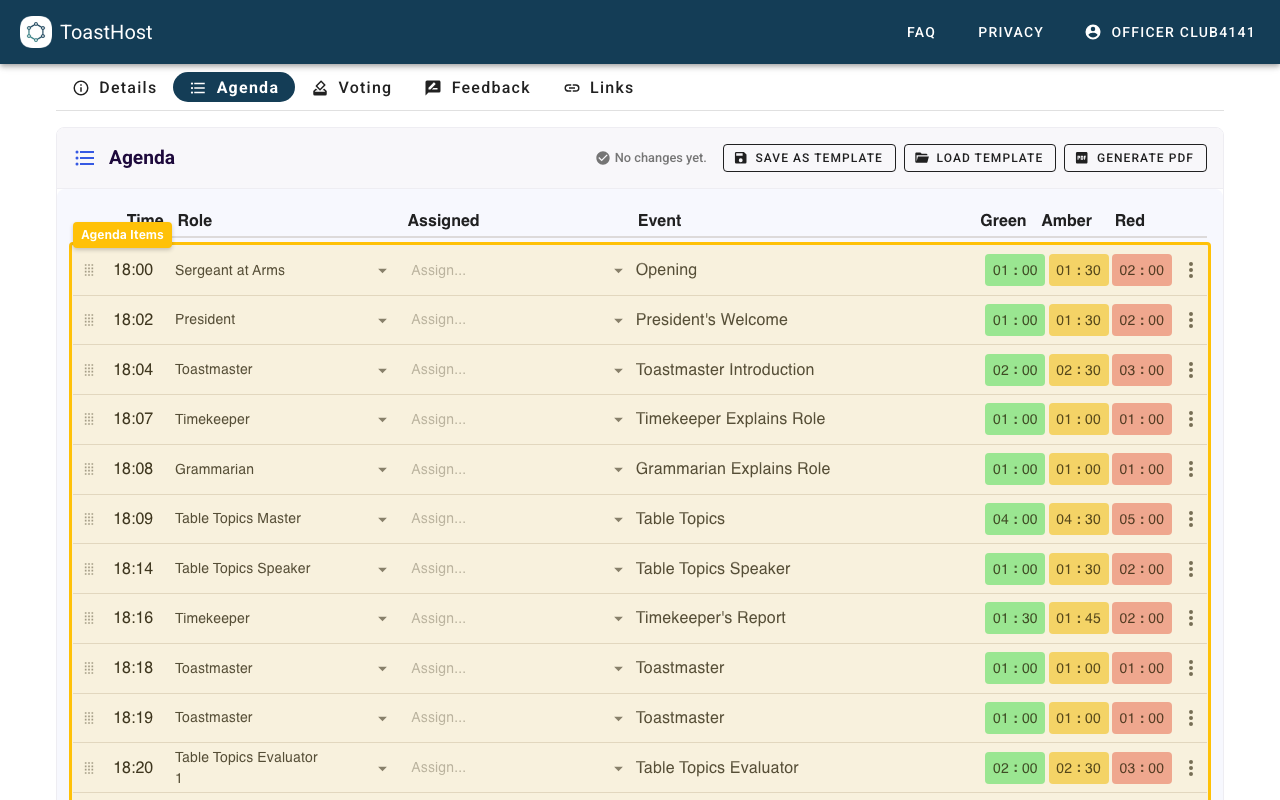
Agenda planning allows you to structure your meeting with segments, timing, and role assignments. A well-planned agenda keeps meetings on track and ensures all participants know what to expect.
How to Access
- Navigate to the meeting you want to plan
- Go to the Agenda tab
- Add, modify, or reorder agenda items
Speech & Role Sign Up grid (paged view)
The Speech & Role Sign Up tab on the club's Meetings page surfaces a windowed grid where you can assign roles across multiple upcoming meetings at once — a different surface from the per-meeting Agenda tab above. The grid pages through meetings five at a time on desktop (fewer on tablet and mobile). On initial load the leftmost column is the next upcoming meeting, with empty placeholder columns trailing on the right when fewer than the window size remain. Paging backward or using Jump to date shifts that anchor, so the leftmost column then reflects whatever range you've navigated to (see "Viewing past meetings" below).
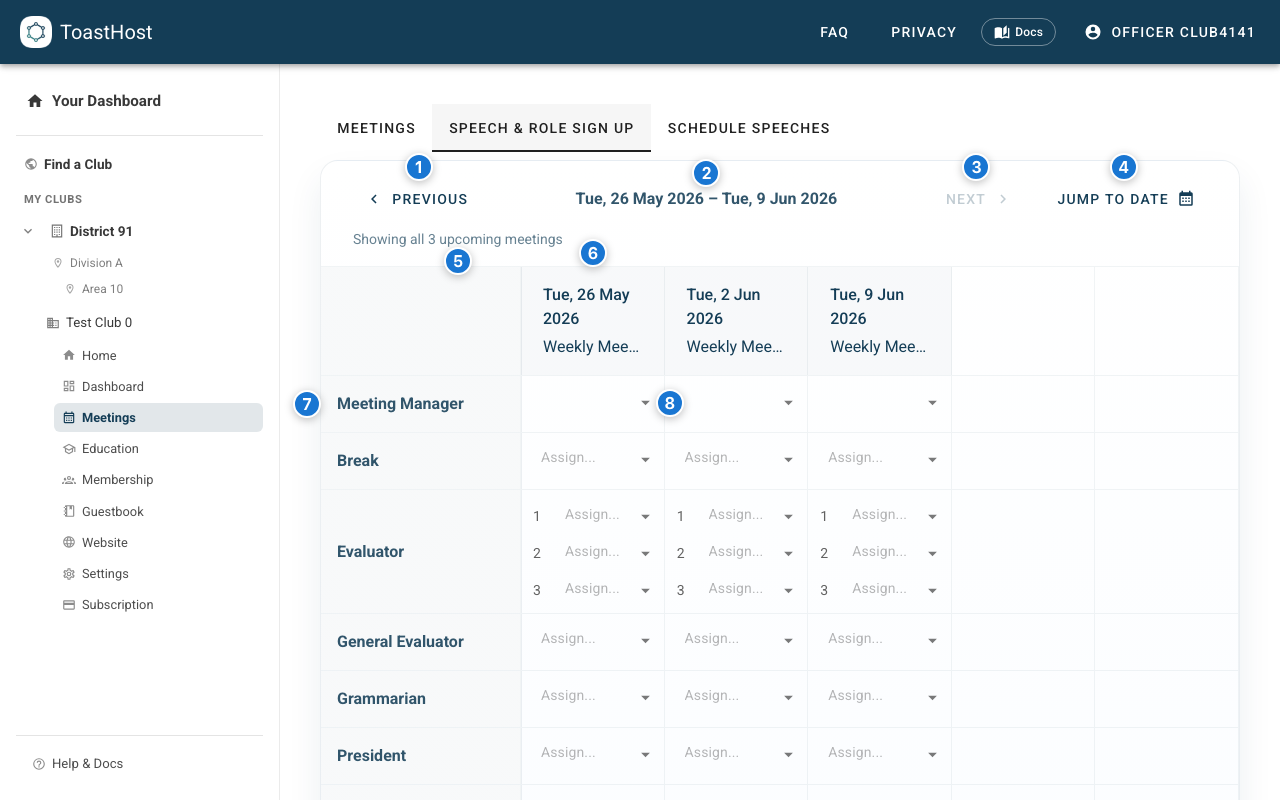
- Previous — slide the window back one meeting. Disabled at the first loaded meeting.
- Date range label — the dates of the leftmost and rightmost visible meeting; updates as you page or jump.
- Next — slide the window forward one meeting. Disabled once the last meeting is the rightmost real cell.
- Jump to date — opens a date picker to anchor the window on the first meeting on or after a given date. The picker has a Today reset.
- Status caption — a screen-reader-friendly summary of what's currently visible: "Showing N of M upcoming meetings", with past- meeting counts when you've paged back.
- Meeting header — date and theme. Clicking the header opens the meeting's detail page.
- Role row — each row is a meeting role; cells are the per-meeting assignment.
- Assignment combobox — type or pick a member to assign. Names that don't fit on a single line wrap up to two lines instead of truncating to ellipsis.
Viewing past meetings
Paging backward exposes past meetings as read-only columns. Their cells are muted, the date header carries a PAST pill, and there are no assignment controls — click the meeting header to open the past meeting's detail page where the full agenda and attendance live.
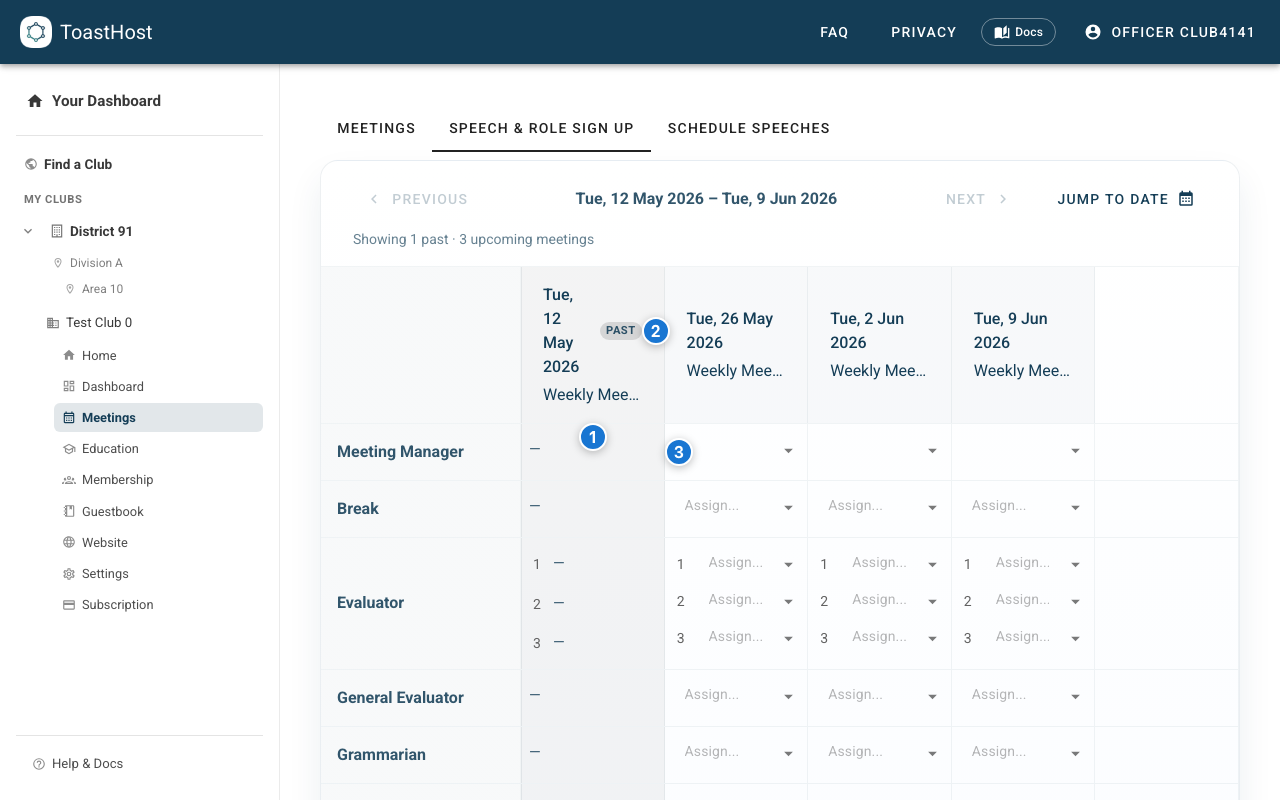
- Past meeting column — muted background; visible only when paging back or via Jump to date.
- PAST pill — appears next to the date.
- Read-only role cell — shows who took the role; no edit controls.
Building an Agenda
Adding Segments
Common meeting segments include:
- Opening - Call to order, welcome, announcements
- Functionary Introductions - Timer, Grammarian, etc.
- Prepared Speeches - Individual speech slots
- Table Topics - Impromptu speaking segment
- Evaluations - Feedback on prepared speeches
- General Evaluator Report - Overall meeting feedback
- Awards/Voting - Best speaker announcements
- Closing - Closing remarks, next meeting info
To add a new segment:
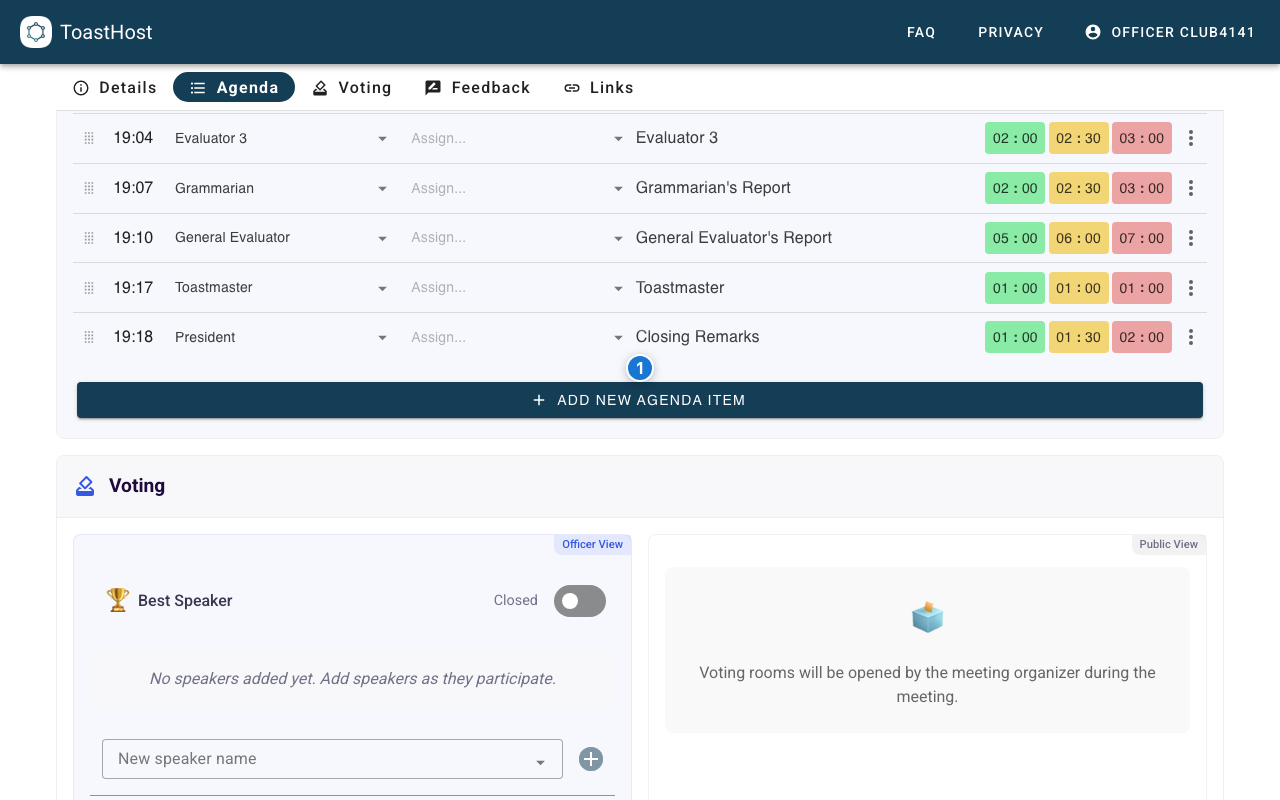
- Scroll to the bottom of the agenda
- Click Add New Agenda Item
- Use the agenda item's actions menu for Advanced Edit to set the role and event name
Setting Timing
For each segment, set:
- Minimum time - Green light on timer
- Target time - Yellow light
- Maximum time - Red light
- Buffer time - Extra time beyond the Red mark (useful for applause and transitions)
Buffer Time (Advanced Edit)
Buffer time adds extra time after the Red mark. This extra time is included in the agenda's calculated start times and total meeting duration.
To set buffer time:
- Open the agenda item's actions menu (⋮)
- Select Advanced Edit
- In Time Marks, set Buffer Time
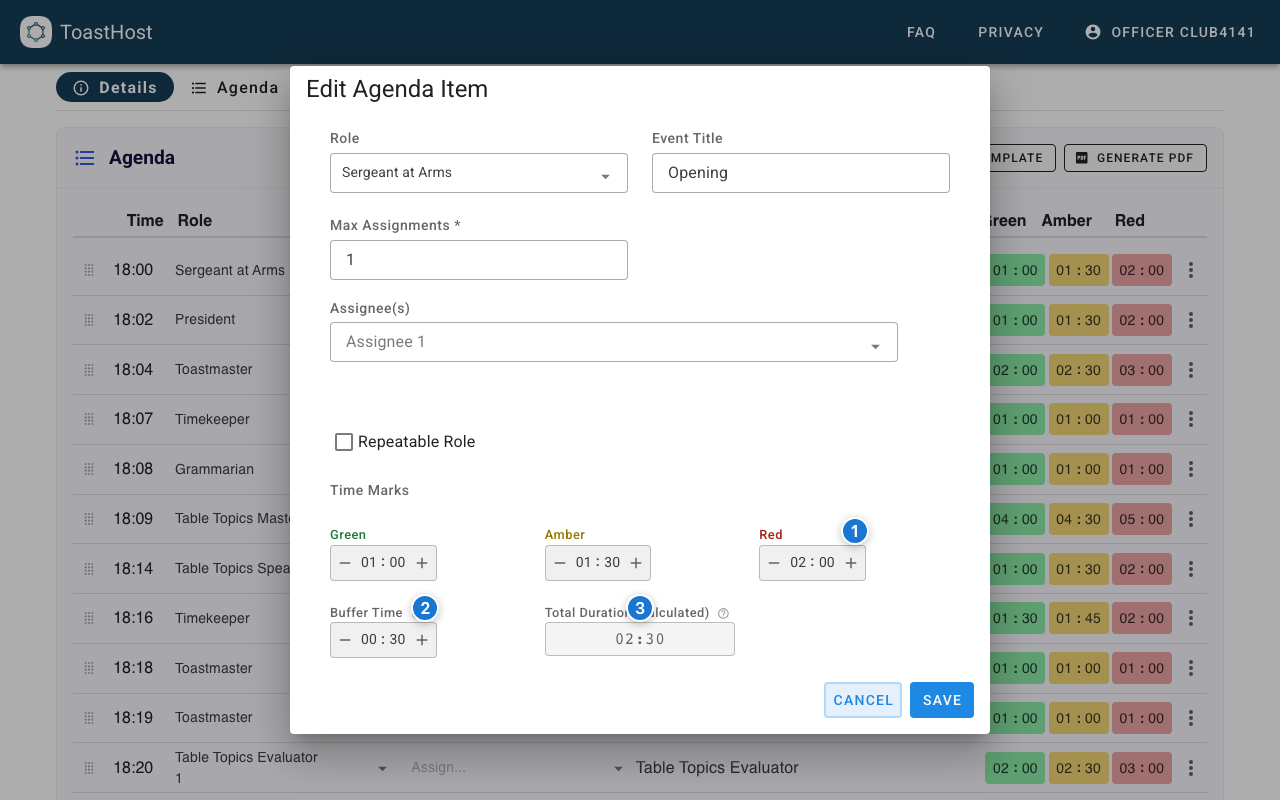
In the dialog:
- Red - The timer's maximum time for this segment
- Buffer Time - Extra time beyond Red (included in agenda timing calculations)
- Total Duration - Automatically calculated (Red + Buffer Time)
Reordering Segments
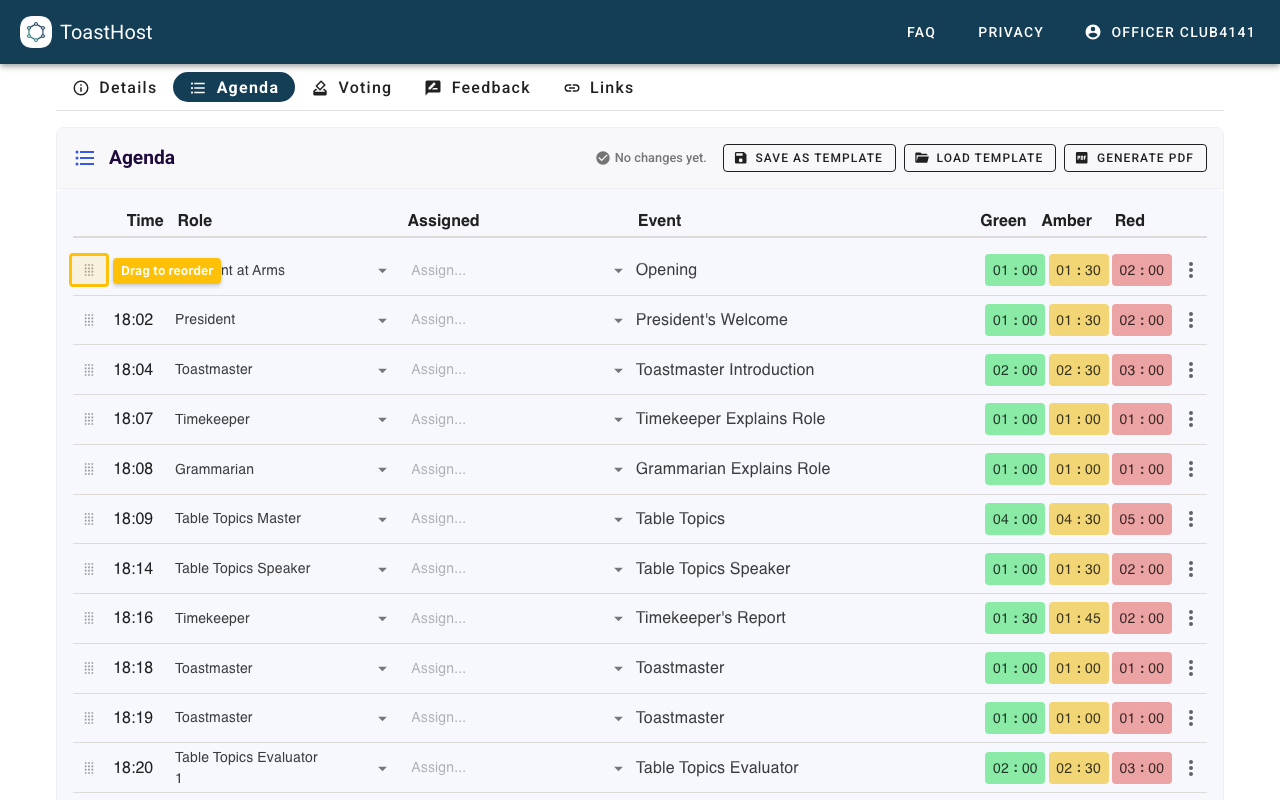
Drag and drop segments to change the order, or use up/down controls.
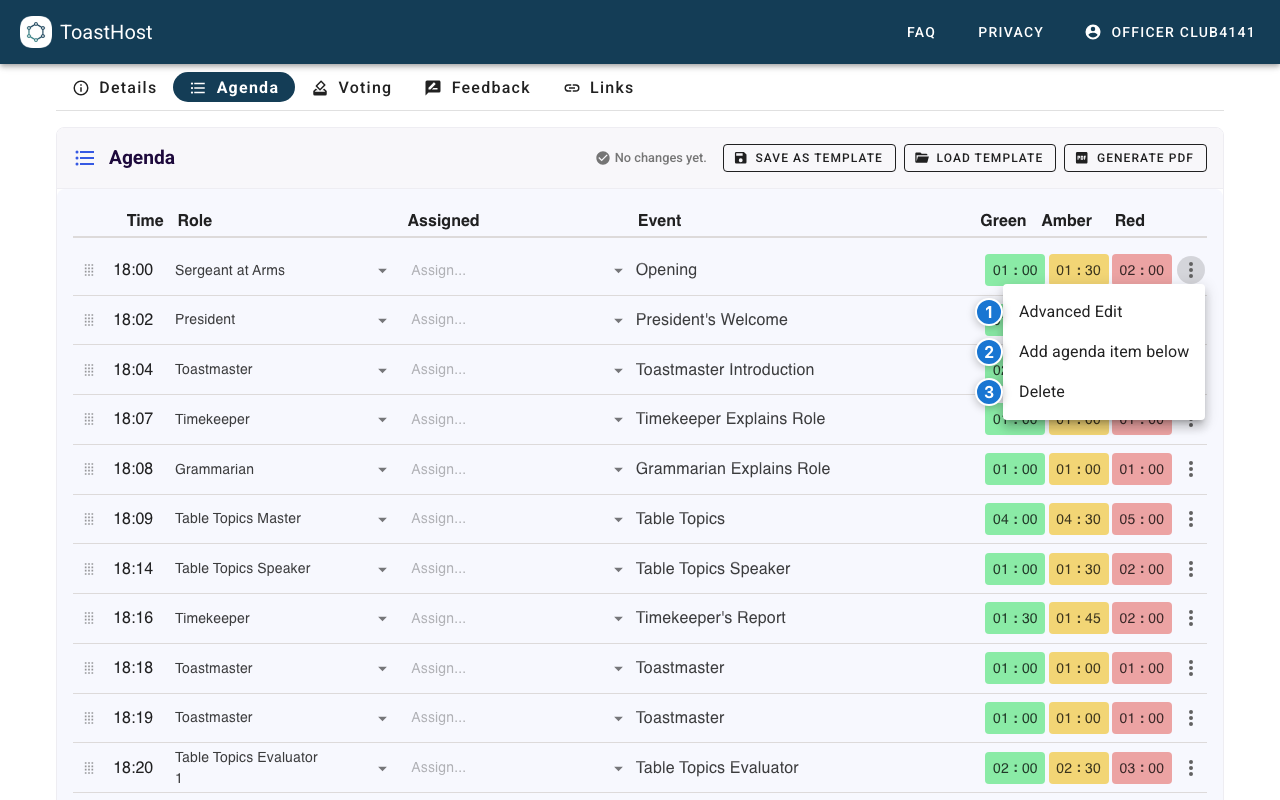
Agenda Item Actions Menu
Use the agenda item's actions menu (⋮) to:
- Advanced Edit - Change the role, event name, and other settings
- Add agenda item below - Insert a new item under the current one
- Delete - Remove the item (you will be asked to confirm)
Speech Slots
Adding Speech Slots
- Add a "Prepared Speech" segment
- Configure timing based on project requirements
- Assign a speaker (or leave open for signup)
For club-wide speech scheduling across multiple upcoming meetings, use Schedule Speeches.
Edit a speech title
ToastHost stores the speech title as the agenda event title. Officers can edit the same title from either the Agenda tab or the Role Signup tab. When you update it in one place, the other view shows the same title.
Method 1: Edit it from the Agenda tab
Use this as the primary workflow when you are already planning the agenda.
- Open the meeting
- Go to Agenda
- Find the Speaker row you want to update
- Edit the inline Enter event description field
- Press Enter or click away to save
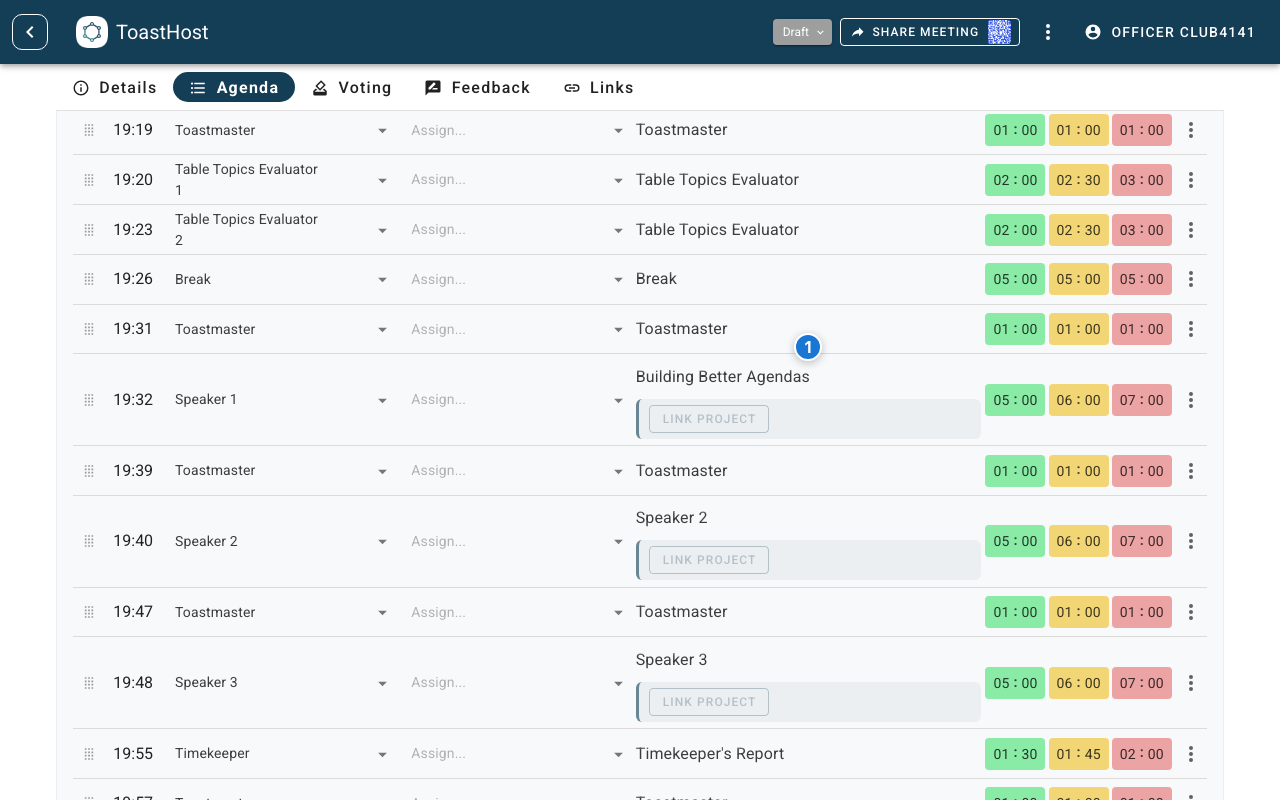
- Use the inline Enter event description field on the speaker row to edit the speech title.
Method 2: Edit it from Role Signup
Use this as a shortcut after a speaker has already been assigned.
- Open the meeting
- Go to Role Signup
- In Speech Assignments, find the assigned speaker row
- Click the speech title text or the Add speech title placeholder
- Type the title
- Press Enter or click away to save
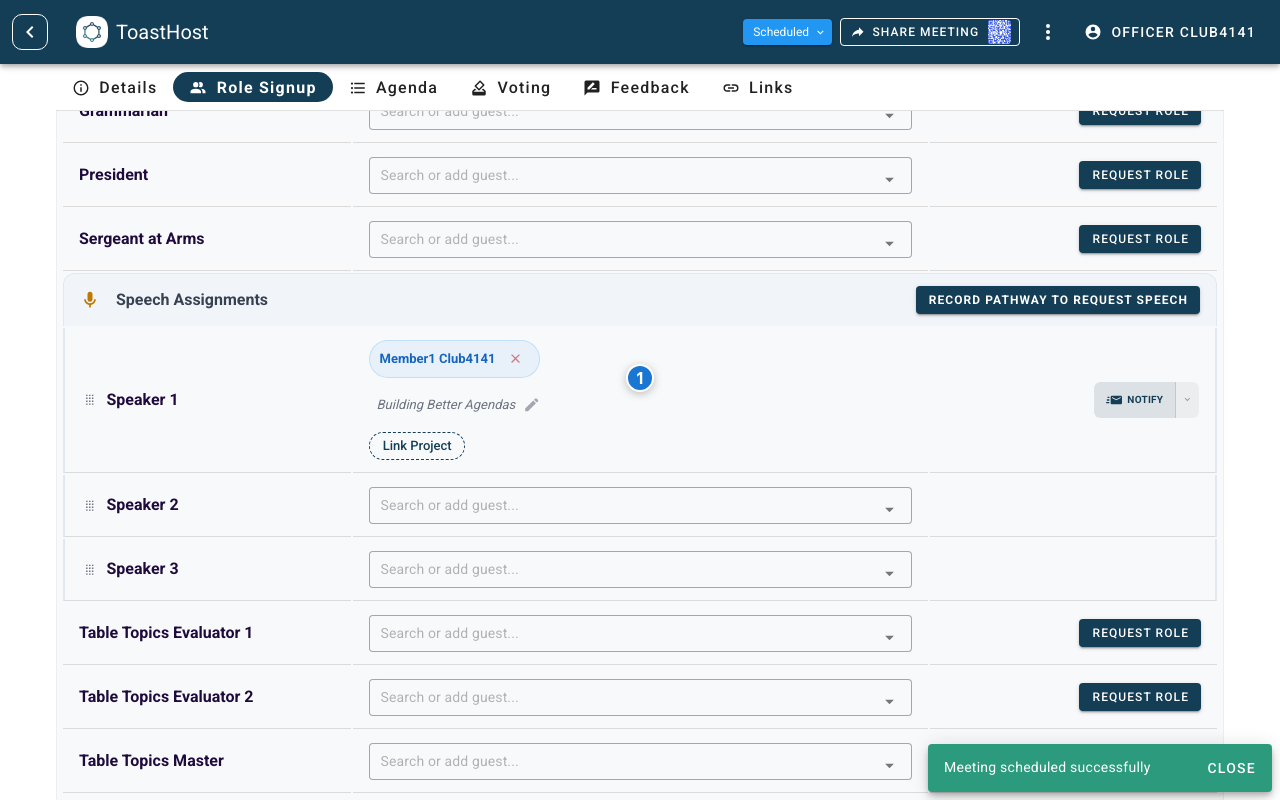
- Click the speech title text in Speech Assignments to edit the same agenda title from Role Signup.
Project-Specific Timing
Different Pathways projects have different time requirements:
- Ice Breaker: 4-6 minutes
- Standard speeches: 5-7 minutes
- Advanced speeches: varies by project
Tips
- Build in buffer time between segments
- Keep timing realistic
- Review agenda before each meeting
- Adjust based on expected attendance
Common Questions
How long should a meeting be?
Most club meetings are 60-90 minutes. Adjust your agenda accordingly.
Can I save an agenda as a template?
Yes, save a well-crafted agenda as a template for future use.
What if we run over time?
The timer helps keep track, but be prepared to adjust. Use Buffer Time in Advanced Edit to add planned slack for transitions or segments that often run long.